
My Bright Midnight

Updated: 1 day ago

If you haven't read about what the Bright Midnight actually is and why it exists, start here it'll make a few of the decisions below make a lot more sense. This is the ride itself: four days, not a lot of sleep, and a route that kept finding new ways to test me right up until the final kilometers.
Getting to Tolga
Getting to the start line is never as simple as it sounds with these events. My route was a flight from Paris to Oslo, followed by a train into the city and then another out to Tolga the next morning. I flew Transavia with my bike in my friend's Scicon Aerocomfort 3.0, while a great bag, my bike is a little too giant for it. I ended up pulling the handlebars off and strapping them in vertically to make it all fit. Flying with a bike is always a bit stressful but luckily all went smooth enough.
I got into Oslo, took the train to the city center, and checked into a hotel right next to the station so I'd have zero stress about making the early train the next morning. After a long travel day, I just ate at the hotel and went to bed early, knowing that night was probably my best shot at real sleep before things got underway.

The train out to Tolga the next morning was easy. There were other racers scattered through the cars, and even with a decent number of bike boxes between us, everything fit fine and the staff were friendly about it. I spent most of the ride just staring out the window at the rivers and lush green landscape, getting more and more excited about what was coming.
At the Tolga station, race volunteers were waiting with a van to shuttle bike boxes up to basecamp. It wasn't far, but the only ways up were a hilly singletrack or a long loop on the road, so having the boxes driven up was quite helpful.
Basecamp and the Night Before
Basecamp was a local sports facility which was well equipped with a full kitchen, an auditorium-style room, showers, bathrooms. I'd brought my full tent specifically to use there, since I was planning to bivy the actual route, but the forecast looked bad enough that I didn't want to start the race with a wet sleeping bag. I slept inside instead.

Building the bike back up went smoothly, and I stashed the empty bag in the basement. I did a short shakedown ride mostly to double-check everything and swing by the grocery store to stock up on dinner and race-start snacks. Check-in was easy getting my tracker, cap, a Bright Midnight strap, and some stickers.
The riders' briefing happened in the auditorium, everyone crammed in tight. The mayor of Tolga said a few words of welcome, then Justinas gave a fairly light overview with a lot of "you'll figure it out," which felt true to the self-supported spirit of the thing. He wasn't there to make anything easier, just to cover the essential safety points. Afterward there was a "pasta party" with lasagna catered in for everyone.
I tried to get to bed early that night, going through my usual routine of packing, unpacking, and repacking my bags two or three times while I second-guessed where I'd put things. Eventually I called it good and laid down. A big echoing room full of people shifting around on crinkly sleeping mats was never going to make for a great night's sleep, but at least I was dry.
Photo Credit: @ospreyimagery Photo Credit: @ospreyimagery Photo Credit: @ospreyimagery
The next morning it was downpouring, validating my decision to sleep inside. I ate breakfast checking the radar every few minutes, hoping it would clear by the start. I geared up in shoe covers and a rain jacket and hoped that would be enough. Luckliy it was, the rain had mostly stopped by the time we rolled down the hill to the start line.
Into the Ultra
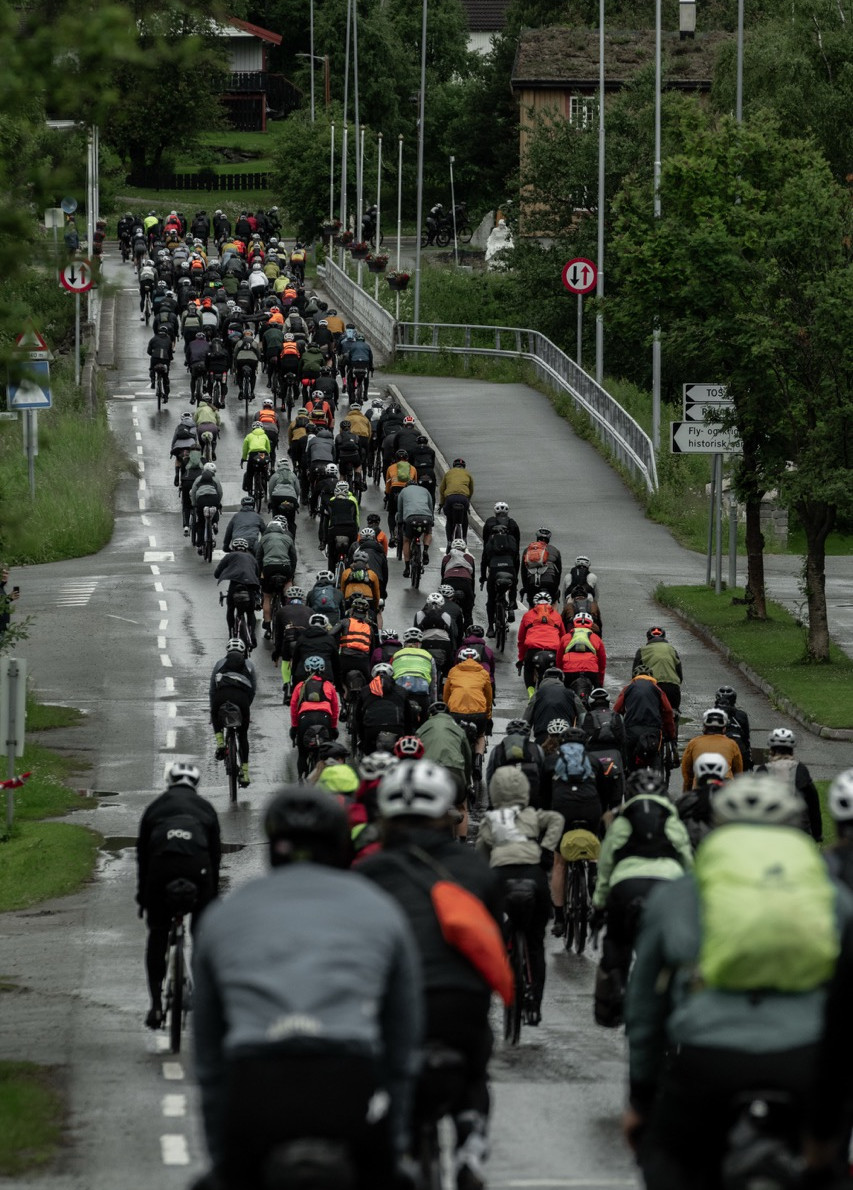
We rolled out in a controlled group, the rain just tapering off. There's always a mental adjustment in the first stretch of any ultra for me, fighting the urge to match other people's pace instead of your own, but the field spread out quickly. The first 80km were relatively flat and gravelly, on-and-off rain, riding mostly on the adrenaline of finally being underway.
Right around 80km came the first real hike-a-bike, and the first glimpse of snow up on the higher ground. That was the moment it really sank in how challenging this was going to be.

At 135km I hit my first resupply, a Coop grocery store in Oppdal. Norwegian grocery stores turned out to be a different animal than what I was used to in France. It was a mixture of being in a rush and a giant store but I found it challenging to find much beyond sugar: Coke, a Snickers, sparkling water and a granola bar.
By 204km, in Sunndalsøra, heavy rain had me waiting it out with a cluster of other riders outside a Circle K. That was my introduction to what became a running theme of the race — hot dogs. With so little pre made food available in the stores, a gas-station hot dog was often the best warm "real food" option going, and at that point, warm was exactly what I needed.

I didn't want to sit too long, so I rolled out into continuing rain toward the big climb up to CP1. Rain pants went on, then off, then back on. I'd been told this stretch had beautiful views; what I actually got was fog, though it was still beautiful in its own moody way. I made it to the top, but the plateau that followed dragged on longer than I'd expected, and the cold really started to bite. I had more layers but held off putting on the dry ones as long as I could.
By 250km and 14 hours in, I rolled into CP1, the sky still lit up bright even though it was nearly 11pm. I was freezing and pretty wiped, so I got some hot soup and tea and sat with the question of whether to keep going or call it for the night. There were rooms available, and it was a good setup, but it also didn't feel quite right to call it already. While eating I sat with a group of German riders and we agreed to try a 20-minute nap before pushing on. None of us actually slept though. We rolled back out around 1am, and I still couldn't tell you where the extra hour went.
A Night That Never Got Dark
Rolling out at 1am into a light sky is one of those experiences that doesn't quite compute the first time. One of the other riders put it well: "my phone camera isn't even switching to night mode." As I made my way off the plateau, it was warmer than I'd expected, luckily the wind had died down, and I had fresh layers on.

Everything was quiet and peaceful for a while. There was a decent climb where I could feel the accumulated fatigue but was still moving okay, but the descent that followed hit differently. I quickly got properly cold and properly tired, I was scanning for anywhere to stop, even though everything around was wet and closed. I checked online and found a store ahead that didn't open until 6am. I pushed on anyway, hoping something, anything, might be open along the way.
At 322km, in Myklebostad, I saw the store in the distance — it was around 5:30am by then, so I'd taken longer than expected. I rolled up unsure whether it would even be open, and then saw a bike parked outside and someone waving from inside. That's how I met Carol, from Poland, and how I experienced my first 24-hour Norwegian grocery store. I was cold enough that just being indoors felt like a relief. Carol had commandeered the store's bread oven to bake a pizza; I grabbed some random snacks and lunch meat, my appetite low but knew I needed more fuel. I sat on the floor for about 35 minutes, eating, warming up, doing nothing in particular, and then I rolled out on my own.
Trollstigen
At 380km and 24 hours in, I hit another round of hot dogs in Åndalsnes, another 35-minute stop, this time with coffee too. I knew a big climb up Trollstigen was coming. The approach involved a fair bit of singletrack and bridges, fun but slow going. Riding alongside another rider, we joked about the perfectly good road we could see running parallel to us on the map the whole time.
The Trollstigen climb itself is beautiful, it's long but manageable. At the top I bundled up for a windy descent, and about midway down I found a café. At 28.5 hours in with no real sleep, a coffee break there was an easy call.
By 435km I'd made it all the way down and could finally shed a few layers. This is when I first noticed just how soggy my feet had gotten, with nearly 30 hours of shoe covers on at that point. The stretch after that was a classic ultra trick: only 15km to the ferry, and it dragged forever, through long tunnels full of cars and false flats that made the distance feel much longer than it was. Nothing you could do but put your head down and just push through.
The Ferry Crossing

Making the ferry crossing had been a pivotal point for anyone's planning from the start. It only ran between 7am and 11pm, and I'd built my entire first push plan around reaching it on day two. The worst-case scenario I'd played out in my head was grinding hard only to miss the last sailing by minutes, with nothing else around and a very long, resupply-free bivy as the consequence.
Since I pushed through night one, I made the 4pm ferry with room to spare. It's free for bikes, and about as simple as it gets — roll on, roll off. There were snacks and drinks on board, but the crossing was short, so I just sat and thought through my next move.

Looking ahead at the profile, there were some serious climbs coming and I was running on roughly 32 hours with no real sleep. I decided to get a hotel on the other side. Checking in before 5pm felt strange, but I was cooked, and it was clearly the right call. At check-in I ran into Carol again. I'd been planning to leave around 10 or 11pm, but he mentioned he was aiming for a midnight departure, and by the time I'd checked in, stored the bike, and grabbed food from the store, a little extra sleep sounded like the better trade. It was a proper hotel with a real room, so I washed my kit and hung it over the radiator to dry.
That was also around when I started coming to terms with the fact that this was going to take longer than I'd hoped, and that a whole set of life factors leading up to the race meant I wasn't as competitive as I'd wanted to be. My mindset shifted fully into adventure mode from there. I still wanted to push and get to the finish as fast as I reasonably could, but the framing had changed.
The Second Bright at Midnight Night
We rolled out right at midnight. After an hour or so of false flat, we hit a mostly hike-a-bike section that immediately confirmed I'd made the right call stopping to sleep. The climb was challenging, and beautiful, but the descent that followed was properly gnarly, luckily I was fresh enough off real sleep to handle it fine.
The next 80km were on-and-off rain with a few heavy patches and moody, quiet views. Around a lake, we passed riders who'd pushed straight through and were sleeping in bus shelters, which did nothing to shake my confidence in the hotel decision. Just before the halfway mark, ahead of a serious climb, another 24-hour grocery store delivered the hot coffee Carol and I had been fantasizing about for the previous six-plus hours.
Refueled and caffeinated, I made my way up the long climb to Videfossen. The road was paved with manageable gradients, waterfalls everywhere, and great views the whole way. After the summit came an incredible lake with startlingly blue water and sunshine; I took a photo there that I still love, where the shoreline looks like a beach made of snow (it was unsurprisingly freezing up there). There's a ski resort nearby, Stryn Sommerski, that would be worth seeing in winter since the whole area is stunning.
A nice stretch of smooth gravel followed, carrying us down and across more rugged terrain, and around 10:30am I made it to Grøtli hotel, still riding with Carol. We went in to warm up, dry out, and get coffee and food. While it was technically between breakfast and lunch, the staff warmed up sandwiches and made us salads anyway. Everyone I met along the way in Norway was like that.
It became another running theme of the trip; feeling exhausted at 10:30 in the morning, then remembering I'd already been riding for over ten hours that day. After refueling, the next 100km went by easily, it was a big U-shape on the elevation profile, a fast gravel descent with some rolling hills, then a long stretch of paved false flat along rivers where the kilometers just flew by. I made good progress through it, though looking back, I don't remember much of the details. I just know it was pretty in the moment but it kind of blurred together.

At some point the terrain switched back to gravel and got more rugged. Carol and I stopped for a photo on a bridge with a rain-swollen river behind us. We were 18 hours into that day and still making progress. From there we climbed back to the main road and up to what turned out to be the highest point on the route, around 1,400m, which we reached close to 8pm. At that elevation and hour, it was seriously cold, with the barren, snow-streaked landscape under an ominous sky which made the whole area feel uninhabitable. The road kept rolling up and down after the main climb ended, and the cold made every extra meter of that drag out.
Calling It a Night
I wasn't sure yet what my plan was, but I knew I needed something warm and more food, so I pushed into the descent shivering, wearing basically every layer I'd packed. At 707km, at 8:45pm, I reached what the map called a "mountain hut" but was really more of a hotel with a hut attached. I was frozen through, and looking around at the other riders, I was not alone. Looking at the profile ahead there were two more climbs and a major descent so I decided to call it for the night and get a bed.

The hotel's restaurant was booked out and far too fancy for dirty cycling kit, but the woman at the desk talked the chef into making Carol and me soup and hot sandwiches, which we badly needed. Behind the main hotel there was a building with multi-bunk rooms; we ended up three to a room, and by the next "morning" several more riders had clearly had the same idea. I managed a shower, but there wasn't time to wash and dry any kit, so after eating I set an alarm for two hours later, around midnight, and tried to sleep. I can't say I slept well, but I did sleep. A bit after midnight Carol rolled out with me at the same time.
The Coldest Descent
The climbs that followed weren't too bad, but the massive descent after them was brutal. Heading down to Øvre Årdal was one of the coldest descents I've ever done it was dark, windy, and seemingly endless. My hands locked up completely from the cold and cramping.
Reaching the bottom was a relief, but nothing was open. We were both shivering and needed a reset; the best we found at first was a bus stop that at least got us out of the wind while we ate some snacks. With slim hope of finding anything warm before the next climb, we spotted a hotel and went to check it out, just to warm up. We got lucky and a guest was walking in right as we arrived, which allowed us to slip in behind him. No one was at the desk, but there were bikes stashed in the stairwell, so we sat there and warmed up. Carol went snooping and came back with a cup of tea he'd made, which was very welcome.
The next climb was one of the most brutal of the route for me personally. It was a long grind, just outside my gear ratio for how my legs were feeling at that point. If I'm making a list of what I'd change, a smaller front ring and or bigger cassette is right near the top. While the views down below were lovely, and the climb did eventually end, but it was demoralizing this early in to the "day".
After the climb, a false-flat uphill led to Tyinstølen, it was a pretty stretch but one I mostly powered through, focused on getting there for coffee and food. The hut was a welcome sight. They had lovely staff and I ate a big bowl of pasta. I was zonked enough to take a 25-minute power nap, this time I fell asleep almost instantly, and it also gave my feet a chance to dry out a bit more. That's around when I first noticed real soreness and sogginess setting in, though it didn't seem like much at the time.
Parting Ways With Carol

Leaving the hut I was fully bundled, hood pulled over my helmet, my signature look by that point. Less than an hour later, after the descent, I was in shorts and short sleeves, sweating. Right around the 800km mark, Carol's knee — which had been bothering him for a while — really started acting up, and he told me to push on without him. It was a bummer to split up. I'd never imagined riding with anyone that long, and I'd genuinely enjoyed it, but I'd gone into the race prepared to ride solo the whole way, so I kept moving.

The wind picked up around then too, hard gusts, and not as a tailwind. The next climb up to Slettefjell, was a real contender for worst of the route. it was steep, straight, and loose gravel made worse by dump trucks actively pouring fresh loose gravel across the road while I was riding it. The area is quite popular and I got passed by older riders ripping along on e-bikes, which added its own flavor of demoralization. There's a photo of me flicking them off after they'd passed but for the record they couldn't see, and it was all In good fun. The descent down the otherside had some hairy moments too, strong crosswind gusts, so I backed off and played it safe.
The Low Point

Looking at the map, it seemed like I just needed to get down this exposed, windy road and I'd hit a solid resupply. What the elevation profile of a 1,131km route doesn't show you is every small hill hiding when looking at it on a tiny screen. In hindsight, the run into Beitostølen wasn't actually that bad, but it just happened to catch me at my lowest point of the race so far.

I told myself it was nothing, and I would be to the store in no time. Instead I found myself hiking my bike up a paved road to get into town. My feet were becoming a real problem by then. The earlier big hike-a-bike had done a number on them, and between that and being tired and hungry, I hit a proper low. I remember yelling something like "who put this hill here" and then just breaking down, sobbing that I couldn't make it and would apparently starve to death on the side of the road. It was a classic ultra low point — usually I get one good ugly cry somewhere in these events, and this one took the cake.
I kept moving, made it up and over, and rolled into Beitostølen, where a cluster of other riders outside the grocery store made for a welcome bit of camaraderie after such a rough patch. I restocked, sat down on the ground, and took my shoes off to actually look at what was going on with my feet. The padding over the bolt holes had compressed and shifted around with all the earlier moisture and was likely the source of a lot of the pain.
Racing the Clock
It was around 4pm, with almost 90km to the next possible town. Doing the math on a route this long was a constant challenge — sometimes 90km flew by, sometimes it crawled — so I stocked up enough food to be fine even if I didn't make it before 11pm.
While eating with my shoes off, I'd looked up a hotel option but decided to push on and see how things went before committing. The climb that followed actually went well, surprisingly so given the low I'd just come out of. The landscape turned barren, almost lunar.

At the top, an unexpected café let me in about ten minutes before closing. It was great to get a hot coffee and a snack before the descent. While I was enjoying that coffee, I checked on the hotel I'd been eyeing and found it fully booked. There'd clearly been a lot of other riders around, but I was still surprised, since it wasn't cheap and plenty of people I'd talked to had been avoiding more expensive options. There just wasn't much else around on this stretch. I found an Airbnb instead, messaged the host to ask how late I could check in, and got an answer of "not much after 10pm" — so I set off to make that work.
I made good progress for a while, enjoying one of the longer solitary stretches of the whole race — a few campgrounds along the way, but otherwise very little built up. As I got close and started feeling good about my ETA, I turned a corner straight into a climb that killed all my momentum and added a wave of stress. I pushed hard to avoid keeping the host waiting and to catch the grocery store before it closed. No full breakdown this time, but I was more than ready to be done with hills for the day.

I made it by 10:15pm. The host checked me in without issue to the nice little multi room cottage full of other cyclists in various states of exhaustion. I dropped my bags and went straight to the store to load up for dinner and the next day. I hadn't decided exactly when I'd leave, only that it would be before anything opened. It had been a stressful evening with rushing to make check-in, then rushing to the store and all that on top of already being stressed about the train and flight I'd booked a little too optimistically. I'd bought changeable tickets, and by that point I'd accepted I was going to need to use that flexibility.
I showered but decided against washing my kit again to avoid having anything wet the next day. After eating and letting the stress settle a bit, I decided a little more sleep was worth more than an earlier start, and pushed my planned departure to 3am.
The Final Day
I was a bit slow getting moving and left a little later than planned, but the extra sleep compared to the night before made a real difference. A couple of decent climbs opened the day, they were paved and nothing that should have been too hard but my feet were properly suffering by then. It had become uncomfortable when standing up to pedal, but it was also uncomfortable when walking too. I pushed through it though. I knew by then I wasn't making my original 4pm train, so I went ahead and pushed the booking to Friday morning, still hopeful I'd finish earlier than that.
The final day was a mix of highs and lows — some great scenery and fast, rolling sections, and other stretches where time just seemed to stop. My early start and limited options along the route anyways made it the longest stretch of the whole race without a resupply, which did not cause any problems per say but was draining by the end.
Climbing up Grimsdalshytta, the bugs were relentless. The wind had died and I was climbing slowly enough to get swarmed constantly. Reaching the top was a huge relief; the wind picked back up, unblocked by the mountains, and I was finally able to outrun the bugs. I'd been looking forward to a resupply at the hut there, but when I arrived I realized it wasn't actually on the route, it was under a kilometer away, but with a stretch of extra climbing to reach it. Since it was still early in the day and I'd stocked up well the night before, I decided to skip it and keep moving. I still stand by that call, even though the next resupply about 60km away took longer than I'd guessed. I had enough food, and plenty of rivers for water.

The skies stayed ominous most of the day but held off raining, and crossing the 1,000km mark felt genuinely great. I was descending and cruising on a high, closing in on the 100km-to-go mark, flowing through some technical trail and having real fun with it.
Mechanical and Mental Breakdown

But as they say, all good things end. I don't remember exactly where, but things slowed down significantly. I was still making forward progress, but I had let my self get too optimistic on pacing. After cresting one of the last big climbs, the descent turned steep and rough, and my brakes started fading and squealing. I knew I was cutting it close on pads, and it was clearly getting worse with the descent still going.
I've changed brake pads on the side of a trail plenty of times, but of course this was the time it decided to fight me. Between feeling rushed, running on such little sleep, and how hot the whole brake system already was, I really struggled to press the pistons back in. I got it together enough to reinstall the wheel and, frustrated, decided to just ride it out and hope the rubbing would burn itself down over the rest of the descent. It didn't. When the trail flattened, I stopped to spin the back wheel and it barely moved a quarter rotation. I pulled everything apart again, and this time I knew I couldn't get away with a half-fix. That's the point where I texted my wife that I was having a mechanical and mental breakdown simultaneously. After a lot of swearing and two more attempts, I had proper brakes again and was back on the trail toward the finish.
The Finish
I hit my first resupply of the day at 5:30pm, 14 hours after starting that morning. I hadn't run out of food, but I'd been living on more gels than I would have liked, so a real grocery store was a very welcome sight. I did the mental math on store hours back in Tolga, wondering if I'd make it in time to grab dinner there. I'd left some cereal behind, but decided to stock up more and carry dinner with me instead. Norwegian stores never quite had the premade sandwiches and salads I was used to from France, but a pack of tortillas and some salami made surprisingly good wraps I could stash in my pack. Sugar was never a problem — Coke, gummies, all of it — but four days in, you need more than sugar.

I already knew I'd make the finish and my rebooked train, so I took the time to eat properly and reset before the final push. Two more climbs followed, but the finish was close enough that I just put my head down and got through them. The last 50km were easy by comparison, welcome after everything before it. There were clear skies, gorgeous light, and bright green rolling grassland the whole way. I don't remember many specifics, just taking in the scenery.
The final stretch was mostly spent in the aero bars. With about 10km to go, I noticed a rider behind me and, partly out of racing instinct and partly wanting to just be done faster, put in an effort to hold him off. I crossed the finish line 109 hours and 19 minutes after I'd started, greeted by Justinas with a big smile and a cold beer.
There's always a strange, slightly anticlimactic feeling to finishing something like this — you push and push, and then it's just over, and life keeps going. But I was thrilled to be done and even more thrilled to get out of my cycling shoes. There was a BBQ going, people hanging around, and after a snack and that beer, I headed into basecamp for the shower and change of clothes that I desperately needed.

Coming Down and Getting Home

I got back to basecamp around 10:20pm and had to be turned around again just ten hours later for my train and flight. After showering and eating the wraps I'd been carrying for the last 67km, it was time to pack up the bike. I decided to do it that night while I still had some momentum — it wasn't the smoothest packing job of my life, but I made it work. While I was in the middle of it, Carol crossed the finish line, and I was really happy to see he wasn't far behind and more so that had made it to the finish at all. We caught up briefly while eating a bit more food before bed.
Though I'd debated about my tent, I slept in basecamp again just to keep the next morning simple. After a quick breakfast Justinas made sure everyone got to the train station, even loading bikes into his own car and shuttling them back and forth personally. It was a small thing, but it stuck with me. The same guy who tells you at the briefing that you're completely on your own once you roll out is the same one making sure you don't have to figure out how to get yourself and a bike box to a train station after four days of racing.

The train back to Oslo was full of other riders, most of us drifting in and out of sleep the whole way. I killed several hours at the airport before my flight with a beer or 2, some pasta, then a patch of floor to lie on, half-watching shows until it was time to board. While the race was finished, it never truly feel over until you make it back home. After an easy flight and a bit of a struggle to get a cab with the bike bag, I was truly finished.
Would I Do It Again
It was an amazing adventure, more challenging than I'd imagined, and I was genuinely thrilled to have finished it at all. While I didn't finish quite as quickly as I wanted to, I was happy to have made my original flight. It's a genuinely spectacular route: real wilderness and remoteness without ever feeling totally cut off. Compared to riding in France, the store hours were far more generous, though I missed the bakeries and the premade food.
People have asked if I'd do it again, and I've said yes pretty much every time without much hesitation. If anyone I know wanted to take it on, I'd sign up again just for the adventure of it. I'm happy with how it went, but I know there's some unfinished business left out on that route.
If you want the gear side of this — what I packed for four days fully self-supported, what worked, and what I'd change after the brake failure and the feet — that's in the gear breakdown. And if you haven't yet, Part 1 covers more on the event organization and why it's built the way it is.

For any of the data nerds the full activity is available on Strava below.


Comments